
Reviewed · HISTORICAL TOURS
Historical Walking Tour of Lisbon
Lisbon history hits different when you walk it. This guided loop ties together squares, streets, and scars from the 1755 earthquake, then tops it off with a high view from Elevador de Santa Justa. It is also in English, runs about 2 hours 45 minutes, and keeps the group small (max 20).
I love how the route is built around major city turning points, starting at Praça Dom Pedro IV (Rossio Square) and moving through the center on foot. I also like that you get practical, on-the-ground suggestions from the guide, not just facts. Even the reviews mention guides like Logan and Nuno as strong storytellers who answer questions and share extra places to eat and explore.
One consideration: you do need to be ready for real walking, including uneven cobblestones and some uphill stretches typical of downtown Lisbon. The tour asks for good weather too, so plan a flexible day if rain is in the forecast.
In This Review
- Key things to know before you go
- A downtown Lisbon story you can actually follow on foot
- Rossio Square to Praça da Figueira, Lisbon’s long timeline in two stops
- Rua Augusta, where Enlightenment architecture tells you the city’s mindset
- Terreiro do Paço (Praça do Comércio), the entry gate and the big turning points
- Chiado, cafes, poets, and the chance to visit Lisbon’s famous bookshop
- Largo do Carmo and Convento do Carmo, where 1755 and 1974 share the same walls
- Elevador de Santa Justa, a viewpoint break plus local tips for the rest of your stay
- Price and value, why $3.62 can feel unreal
- Pace, footwear, and how small groups change the experience
- Who this tour fits best, and who should choose something else
- Should you book this Historical Walking Tour of Lisbon?
Key things to know before you go
- A tight downtown loop that strings together Lisbon’s big squares and landmarks over about 2h45
- English guides with strong storytelling, with names like Logan, Nuno, Bruno, Kiara, and Andre showing up often
- 75 percent of the value is the context, the why behind what you see, from the crown battles to the earthquake rebuild
- Free entry stops along the way, so you are not juggling extra tickets mid-walk
- Small group size (max 20), which helps with pace and questions
- A final viewpoint moment at Elevador de Santa Justa to reset your legs and your eyes
More Lisbon miradouros linked on foot:
- Lisbon: History, Stories and Lifestyle Walking Tour★ 4.8 · 10,902 reviews
- Best of Lisbon Small-Group Guided Walking Tour★ 5.0 · 4,869 reviews
- Lisbon: Food and Wine Small Group Walking Tour★ 4.9 · 4,082 reviews
- Best of Lisbon Walking Tour: Rossio, Chiado & Alfama★ 4.9 · 2,700 reviews
A downtown Lisbon story you can actually follow on foot
This is the kind of tour that makes the city feel legible. Instead of tossing dates at you, the guide connects what you see in each place to what Lisbon was trying to do at the time, survive, rebuild, trade, or rule. You start in the lower downtown core and gradually work your way upward, ending where you can look back over the center.
The stops are also chosen for contrast. Rossio and Figueira bring you into the older layers of the city. Rua Augusta is where Enlightenment-era thinking shows in the streetscape. Then you land in the grand set piece of Terreiro do Paço, before shifting into neighborhoods where culture, books, and politics all matter. By the end, Santa Justa gives you the geography lesson.
Rossio Square to Praça da Figueira, Lisbon’s long timeline in two stops
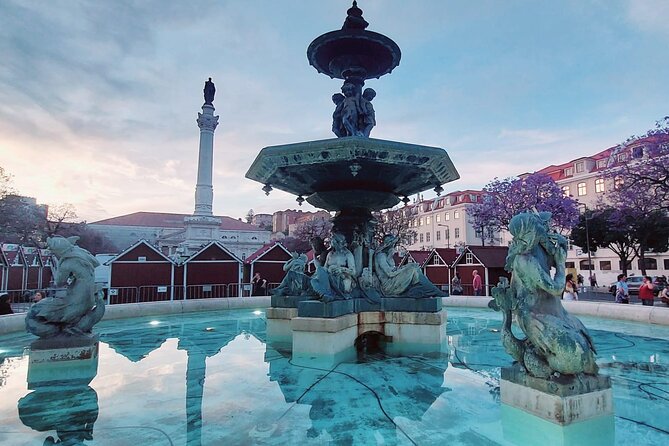
Your first anchor is Praça Dom Pedro IV (Rossio Square). You learn that the area links back about 3,000 years to the first inhabitants who established in the city. That is a great opener because it reminds you Lisbon did not start with the ocean views and postcard tiles. It started as a place people built and lived, long before the grand squares you picture today.
You also get a close look at the square’s intricate floor work. It is the sort of detail that you might otherwise rush past. Here, the guide helps you see it as part of the city’s layered identity, not just a decorative surface.
Next is Praça da Figueira. This square matters because it stood over the site of a major public hospital that was destroyed in the 1755 earthquake. The guide also frames it in terms of power struggles, explaining battles fought over the crown between Portugal and its neighbors. This stop is short, but it works, because it gives you a sense of Lisbon as a political node, not only a scenic one.
Rua Augusta, where Enlightenment architecture tells you the city’s mindset
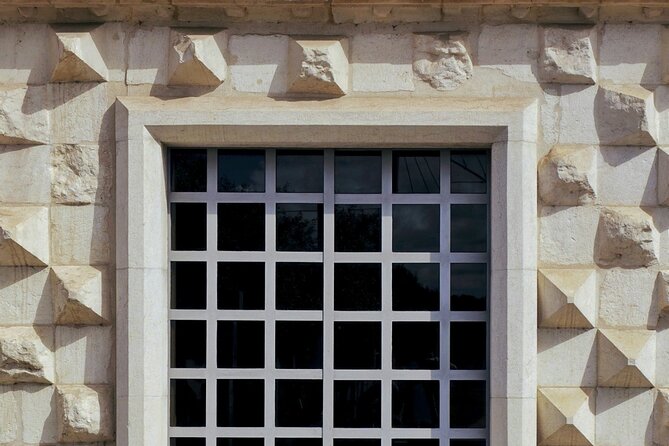
From the squares, you walk downtown through Rua Augusta, Lisbon’s main artery. This is not just a “walk to the next stop.” It is a living corridor where the architecture reflects how the Enlightenment era shaped rebuilding and civic pride.
The key thing I like about this stretch is that it turns a street into a lesson. You can look up and notice the style choices the guide points out, and you start to understand why certain parts of the center feel more coordinated than other older corners. If you like walking tours that make you pay attention instead of drifting, this section does that job.
Terreiro do Paço (Praça do Comércio), the entry gate and the big turning points
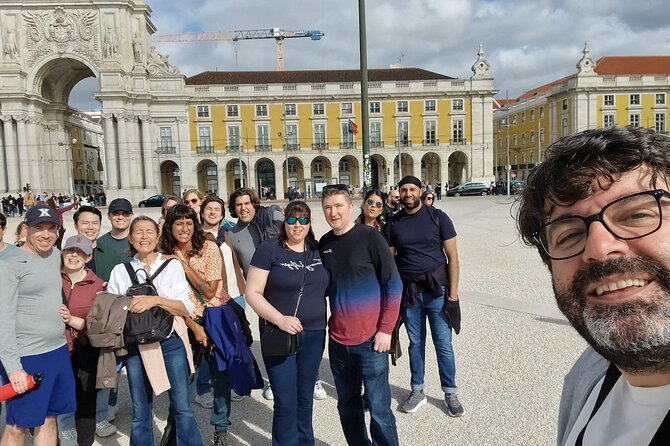
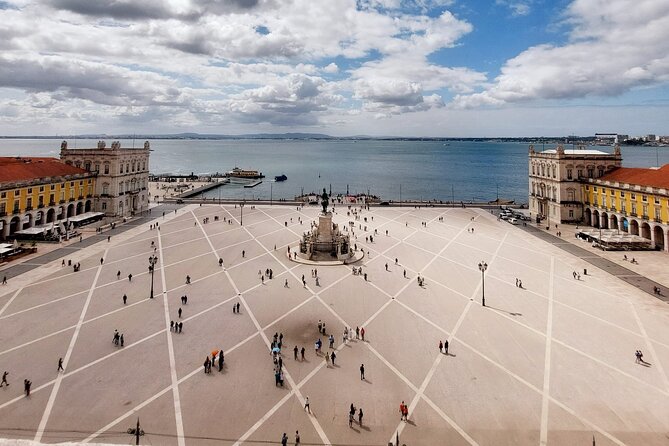
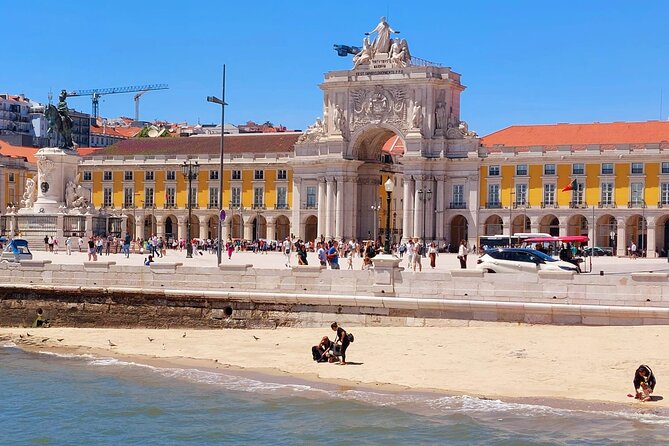
Your main square stop is Praça do Comércio (Terreiro do Paço), and it gets a full 30 minutes. This is the kind of place where Lisbon feels theatrical in a useful way. The guide explains how it has served as the city’s entry point for millennia, which helps you picture the flow of people and goods as Lisbon grew.
Then comes the heavier material. You hear stories tied to the Age of Discovery and the 1755 earthquake, plus what happened during the rebuilding efforts and who played roles in that recovery. This is where the tour becomes more than sightseeing. It is the moment you start connecting Lisbon’s architecture to Lisbon’s survival instincts.
A practical note: standing and listening works best if you take a minute to choose a spot and keep your eyes moving between the square and the façades around it. If you do that, you will remember this stop long after you leave.
More of pre-earthquake Lisbon, where it survives:




Chiado, cafes, poets, and the chance to visit Lisbon’s famous bookshop
After the formal sweep of the waterfront square, the tour turns toward Chiado, Lisbon’s art district. You get 20 minutes here, which is just enough time to understand the vibe and still feel momentum.
The guide points out how Chiado mixes everyday life with culture: cafes, theaters, and bookshops. This stop also has a literary spotlight, with stories of proclaimed poets and writers. The highlight for book lovers is the chance to visit the oldest bookshop in the world, the famous place many guides point out in Chiado.
Even if books are not your thing, this is still worth your time. Chiado shows you a different Lisbon than the earthquake-rebuild squares. It is about how the city supports ideas, conversation, and performance. And if you like planning the rest of your trip, this is also where guides often steer you toward what to see next in the same spirit.
Largo do Carmo and Convento do Carmo, where 1755 and 1974 share the same walls
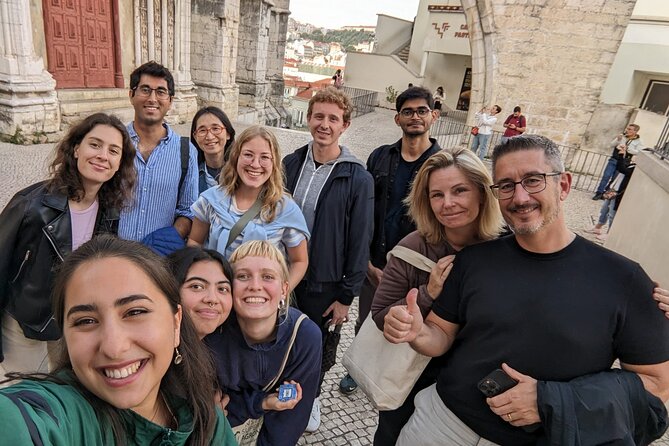
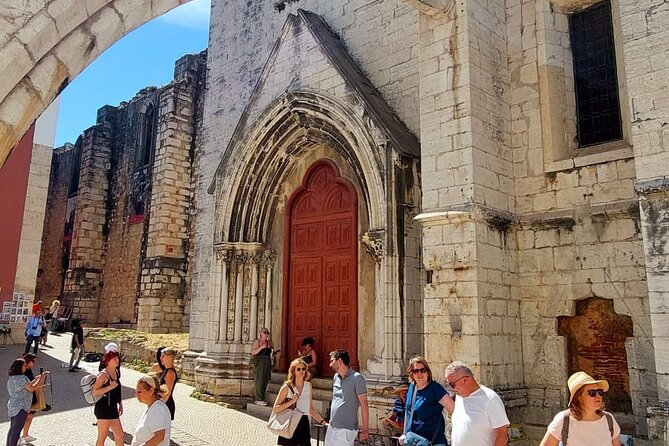
Largo do Carmo is a strong 30-minute stop. The centerpiece is Convento do Carmo, described as the second oldest building in the city and one that barely resisted the devastation of the 1755 earthquake. The guide uses the building to show you how damage can become part of the story, not just a tragedy to move past.
Then you get a second time period layered onto the first. You hear about social events in Portugal’s history tied to this place, including the 1974 Carnation Revolution, often remembered as one of the most peaceful political changes in the modern era. The combination works because it connects a physical landmark to a political turning point.
This stop is also where your legs will feel it. Take short breaks if you need them, and keep an eye on where you put your feet. The whole center can be uneven, but this area especially rewards careful walking.
Elevador de Santa Justa, a viewpoint break plus local tips for the rest of your stay
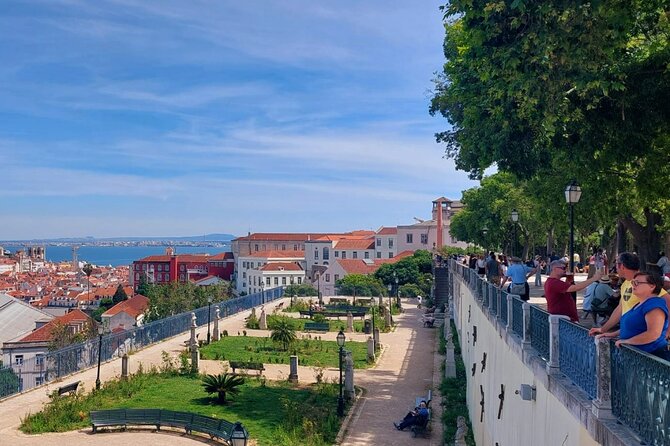
The tour ends with a stop at Elevador de Santa Justa for about 15 minutes. It is the payoff: a birds-eye view of downtown Lisbon, letting you see the street grid, hills, and how everything ties together visually.
Even more important, the guide uses the final minutes to pass along local tips for what to do next in Lisbon, including where to eat and other viewpoints. The best tours do this well because you are still oriented. You can take those suggestions and immediately apply them, instead of losing the momentum after you scatter to your hotel.
In the reviews, guides like Logan and Andre also get praised for sharing lists of ideas after the walk. That kind of follow-up makes this tour feel like a start, not a one-off.
Price and value, why $3.62 can feel unreal
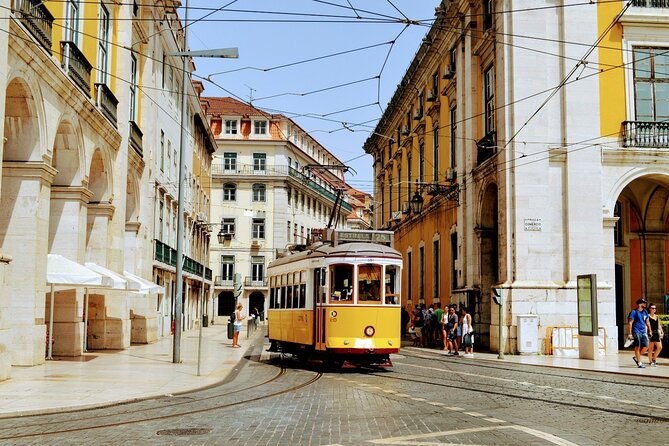
At $3.62 per person for a guided historical walking tour that lasts nearly 3 hours, the value math is hard to ignore. You are paying for a professional guide, a route designed to teach you what to notice, and hand-picked suggestions for continuing your Lisbon days.
The free entry points along the way also matter. The tour lists admission as free for the stops, meaning you are not adding surprise costs mid-itinerary. That keeps the tour accessible and helps you stick to a simple budget, which is a big deal if you are doing multiple activities in one week.
My take: this is the kind of price that makes sense when you want a city introduction but you do not want to blow your budget on a museum ticket plus transit plus extra fees. If your main goal is to understand Lisbon quickly and then explore on your own, this is a smart use of time.
Pace, footwear, and how small groups change the experience
This tour is capped at 20 travelers, and that size shows in the feel. You get time at each stop without the guide feeling rushed or forced to speak to everyone from far away. In the reviews, guides like Constanza, Bruno, Kiara, and Antonio are repeatedly mentioned for checking the group, keeping a comfortable pace, and answering questions.
Now the practical part: wear comfy shoes. Lisbon sidewalks can be beautiful but also uneven, with cobblestones that roll underfoot if you have the wrong soles. One reviewer specifically advises bringing a water bottle and sunscreen, and I agree. Even in mild weather, you walk enough for it to matter.
Also, expect some uphill movement, because the tour climbs through downtown to reach Santa Justa and ends near the Carmo area. One review notes the guide helped the group with uphill roads, even for a wide age range. So if you are concerned about hills, you will want to bring a steady walking pace and be ready to take breaks.
Who this tour fits best, and who should choose something else
This tour is ideal if you want a history-forward introduction without turning it into a museum marathon. It suits first-timers, and it also works if you have already been to Lisbon but want a smarter “what am I looking at” lens.
You will probably enjoy it most if you like:
- learning how earthquakes, rebuilding, and political power shaped Lisbon’s center
- listening to stories tied to specific places, not generic background
- getting a few concrete next-step recommendations for food and viewpoints
If you prefer long quiet time at monuments, or you hate walking on uneven streets, you might find the pacing a bit full. The tour is dense with stops. You also need decent weather since the experience requires good conditions.
Should you book this Historical Walking Tour of Lisbon?
I think you should book if you want the fastest way to understand central Lisbon: squares with major historical weight, a signature street built around Enlightenment ideas, and a final viewpoint that helps everything click. The price is so low for what you get that it makes this an easy first-day anchor.
I would skip it only if your day is already overloaded with other timed attractions, or if you know you cannot handle a 2h45 walk on cobblestones and some uphill segments. If that sounds like you, you could still enjoy the city more by choosing a shorter or more seated option.
Bottom line: for value, storytelling, and a clean route that ends with a view, this is a strong choice to kick off your Lisbon stay.
Fresh across the seven hills
- Full-day Private Tour: Fátima Sanctuary, Batalha, Nazaré, Óbidos
★ 5.0 · 6 reviews - Porto Private Tour from Lisbon
★ 4.5 · 6 reviews - VIP transfer from the airport to Lisbon hotels
★ 5.0 · 6 reviews - Arrábida Wine Tour – 3 Wineries, Traditions & Views from Lisbon
★ 4.5 · 6 reviews - Lisbon Photoshoot: Capture Your Adventure
★ 5.0 · 6 reviews - Lisbon: Romantic Sunset Cruise With Wine & Portuguese Tapas
★ 5.0 · 6 reviews - Lisbon: Sintra, Pena Palace, Belém Tour + sunset Boat Cruise
★ 5.0 · 6 reviews
Historical Tours, compared.

Daytime or Sunset Boat Cruise with History and Wine
Read our review →
Explore Lisbon by Tuk Tuk: History and Viewpoints
Read our review →
Private Tuk Tuk Tour Through Lisbon’s Historical Streets
Read our review →
Lisbon Sunset Sailing with Portuguese Wine and History
Read our review →
Live Fado Show in Historic Alfama with Port Wine
Read our review →
Private Lisbon-Arrábida Wine Tour: 3 Wineries, Coast & Heritage
Read our review →
Browse the lists this tour appears in