

Reviewed · SIDECAR TOURS OF LISBON
Lisbon Historic – Private Vintage Sidecar Tour
Lisbon is a city of sharp corners and big views, and this private vintage sidecar tour gives you both quickly. You get a tight loop that ties together major historic squares and panoramic stops without the usual half-day scramble.
I really like that the timing is built for sanity, with an hour that still covers multiple Lisbon highlights. I also like the small-group feel, since it’s private for up to 2 and includes pickup options. The one thing to consider is simple: with only about 1 hour, you are not meant to linger long at each site.
In This Review
- Key things to know before you go
- Why a 1-hour Lisbon Historic sidecar loop works
- Price and value for a private sidecar day in miniature
- Meeting at R. Garrett and the easiest way to get rolling
- Stop 1: Praca do Comercio, Lisbon’s emblem and its rebirth
- Carmo Church ruins: when archaeology is part of the view
- Elevated belvedere: panoramic Lisbon without the long hike
- Garden break with kiosks and tree names you can spot
- Liberty Avenue to Baixa: the ride through Lisbon’s main spine
- Rossio: the square of shops, theatre, and April-June jacarandas
- Baixa and the Marquis of Pombal’s rebuilding logic
- Lisbon Cathedral and cloister ruins: church, cathedral, and older layers
- Sophia de Mello Breyner Andresen viewpoint: city views with a poet’s name
- Braganzas-era building and Lafontaine fables on tiles
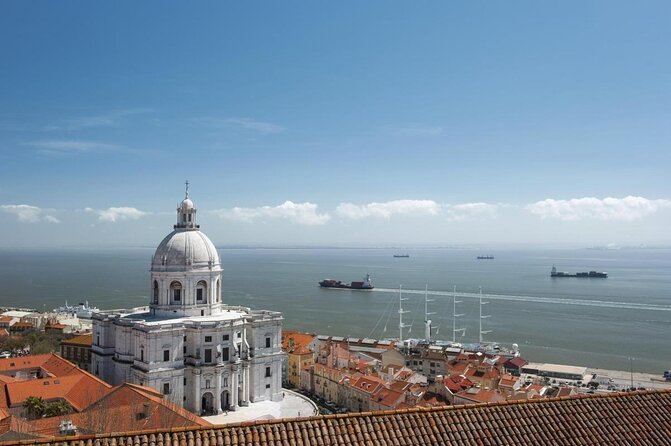
- National Pantheon: neo-Manueline architecture and a dome view
- Flea market and the pantheon view, with street art in the mix
- Guides, pacing, and what “private” really changes
- Who this tour is best for (and who may want to skip)
- Practical notes on comfort and ride realities
- Should you book this Lisbon Historic Private Vintage Sidecar Tour?
- FAQ
- How long is the Lisbon Historic private vintage sidecar tour?
- How many people are in a private tour group?
- Is pickup available?
- What languages are available?
- Where do we meet for the tour?
- Can I cancel for a refund?
Key things to know before you go
- Private up to 2 means you can move at your pace and ask questions without competing for attention.
- Vintage sidecar ride time is the point, not just transport, so the scenic moments are baked into the schedule.
- You’ll hit Praca do Comercio, Rossio, Baixa, plus viewpoints and ruins, all in one compact loop.
- There’s a planned garden break with kiosks and unusual tree names you can actually spot.
- The route focuses on visible history, from church ruins to Pantheon architecture and street art nearby.
Other sidecar runs through the hills:
- Private Tour: Best of Lisbon by Sidecar★ 5.0 · 377 reviews
- Lisbon: Sidecar Tour★ 5.0 · 123 reviews
- Lisbon: Belem Motorcycle Side-car Tour★ 5.0 · 48 reviews
- Lisbon Sidecar Tour ( the netflix one)★ 4.9 · 41 reviews
Why a 1-hour Lisbon Historic sidecar loop works

Lisbon can swallow your day fast. This tour is designed for people who want the big hits and then still have energy left for dinner, a gelato crawl, or a longer wander on your own.
That hour stays productive because the stops are smart mixes. You get squares and avenues where the city’s layout makes sense. You also get ruin-and-panorama moments where the payoff is immediate, because you can see what you’re hearing about.
Price and value for a private sidecar day in miniature
The price is $155.42 per group, up to 2 people, for about an hour. That sounds high if you compare it to a walking tour, but sidecar tours are about vehicle time, guide time, and the convenience of having someone else do the routing.
If it’s just you two, you’re essentially paying for a private guide experience in a classic ride format, with pickup offered. If you’re traveling solo, it’s still a fair option when you value comfort and direct attention, but your per-person cost is obviously less friendly.
Meeting at R. Garrett and the easiest way to get rolling
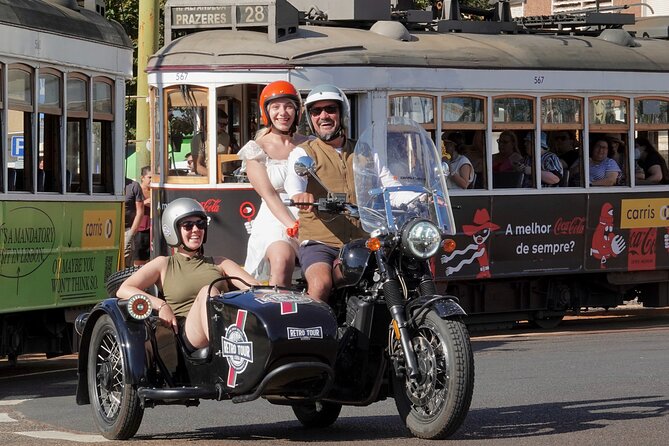
Your meeting point is R. Garrett 88, 1200-204 Lisboa. The tour ends back there, so you don’t end up piecing together your own return plans.
Pickup is offered, which helps a lot in Lisbon, where getting around can mean hills and sidewalks that feel like they were designed for locals in good shoes. You’ll also use a mobile ticket, which cuts down on fuss at the start.
Stop 1: Praca do Comercio, Lisbon’s emblem and its rebirth

You start at Praca do Comercio, a classic central square that helps you calibrate Lisbon fast. It’s a place where the city feels open, built for movement, and easy to understand from a distance before you crawl into the tighter streets.
One detail worth paying attention to is how the square came back after a major fire. You’ll hear that it was destroyed by a gigantic fire in 1988, and the reconstruction was carried out by architect Alvaro Siza Vieira. That means you are looking at a modern rebuilt core, not just an untouched postcard.
If you like context, this stop is a strong opener. If you prefer to hop straight to viewpoints, it still works as a “set the stage” moment.
More of pre-earthquake Lisbon, where it survives:



Carmo Church ruins: when archaeology is part of the view
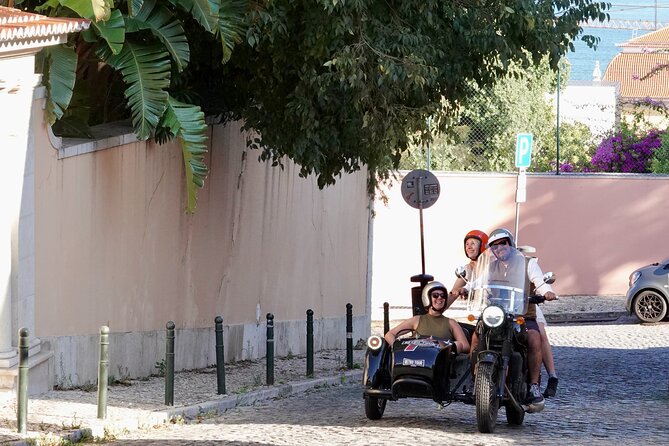
Next is the Gothic ruins of Carmo Church, known for housing a varied archaeological collection. Even without museum-style roaming, the cloisters and leftover structure tell you something important: Lisbon’s layers are not abstract. They are visible.
This stop is also a breather. The ride continues, but you get a calmer pace here where you can look at stones and ask why they were preserved. The drawback is also real: if you want long museum time, this is more of a guided highlight than a deep dive.
Elevated belvedere: panoramic Lisbon without the long hike

After that, you go to an elevated belvedere for panoramic views of Lisbon and its colorful rooftops. This is where the sidecar format makes sense. You’re not just standing somewhere waiting for a perfect angle. You’re being taken to the spot where the city opens up.
Bring your eyes, not your phone only. Move your gaze between the wide view and nearby details, because Lisbon’s “colorful roofs” also include how neighborhoods stack and how streets curve.
If the weather is bad, expect the viewpoint time to feel less magical. But when skies cooperate, this portion delivers.
Garden break with kiosks and tree names you can spot

A fun part of the itinerary is the stop for beautiful gardens with iron tree, cheese tree, or kapok tree, plus kiosks. This isn’t just for a photo. It’s a chance to slow down, reset your senses, and enjoy a drink in a place that feels made for lingering.
This is also a social stop. One guide note from a recent experience described coffee cups and local sweets being offered during the break. That kind of small hospitality matters when you’re doing a compact tour and want it to feel warmer than a checklist.
If you’re the type who hates breaks, you might find this portion a little “scheduled.” For most people, though, it’s a good pause in the middle.
Liberty Avenue to Baixa: the ride through Lisbon’s main spine

Then comes Liberty Avenue, followed by the approach into the Baixa District. I like this sequence because it shifts you from grand, open streets into the structured grid of the downtown core.
From a comfort perspective, the move between these areas can save you energy. From a learning perspective, you start seeing Lisbon’s urban logic: where the city was rebuilt, and how planners shaped movement through streets that feel both practical and dramatic.
Rossio: the square of shops, theatre, and April-June jacarandas
You’ll reach Rossio, a square that blends everyday life with history. You get stores and tourist energy, but you also get named landmarks and seasonal color.
Two highlights to keep in mind here:
- The National Theatre, previously tied to the court of the Inquisition.
- The purple Jacarandas you can see in April-May.
If you’re visiting outside that window, you still get the square’s atmosphere, but the jacaranda magic is the seasonal bonus. I’d still call this a worthwhile stop because it teaches you how Lisbon’s cultural institutions sit inside everyday streets.
Baixa and the Marquis of Pombal’s rebuilding logic
In Baixa, you’re looking at the results of the 18th-century reconstruction connected to the Marquis of Pombal. The route frames it as urbanistic logic, with an emphasis on being resistant to future tremors.
That phrasing matters. It’s not just “cool old streets.” It’s a reminder that Lisbon’s form is a response to catastrophe and planning. When you stand in Baixa and look down long streets, you can almost see the planning goals: order, movement, and rebuilding that tries to survive what came before.
The main drawback here is time. In an hour, you can’t walk every street to its end. You get guided orientation, which is perfect if you want to understand the district quickly.
Lisbon Cathedral and cloister ruins: church, cathedral, and older layers
Another important historic anchor is a stop describing a church that was built in 1150, later becoming cathedral in 1250. You’ll also hear the idea that it was built close to the main mosque during the Muslim occupation, and that ruins in the cloister suggest remnants of Roman civilization.
That is the kind of detail that makes Lisbon feel real. You’re not just seeing architecture. You’re seeing how successive eras reused space and left traces that survived.
If you like religious architecture but hate long waits, this stop is balanced. It’s guided enough to connect the dots, but it doesn’t demand hours of slow exploring.
Sophia de Mello Breyner Andresen viewpoint: city views with a poet’s name
Next is a point of view dedicated to poetess Sofia de Mello Breyner Andresen, who died in 2004. I love viewpoints that are tied to a person, because it turns a view into a story instead of just a snapshot spot.
This is another moment where the sidecar timing pays off. You’re not treating the day as a workout, but you’re still getting height and perspective.
Braganzas-era building and Lafontaine fables on tiles
You also stop at an old building, described as one of the first churches that changed a lot over time. The tour frames it as connected to the Braganzas, including use as a hotel for the last Portuguese dynasty, and it also mentions about thirty panels from Lafontaine’s fables.
Even if you are not a tile expert, you’ll probably enjoy this stop because it mixes politics, everyday storytelling, and visual culture. Azulejo panels can be surprisingly readable once someone points out what you’re looking at.
The consideration is that this stop may appeal more if you enjoy art details. If you want only open-air views, this is a slightly more “look closely” moment.
National Pantheon: neo-Manueline architecture and a dome view
The National Pantheon of Lisbon is a major stop, and the itinerary treats it like one. It’s described as an imposing monument, housing graves of illustrious Portuguese personalities, with neo-Manueline architecture and a sumptuous interior.
You’ll also hear about the dome, which offers a panoramic view of the city. That dome element matters because it gives you two kinds of Lisbon in one: the architecture you can study and the view that lets you place neighborhoods in your mind.
If you have limited time, this is one of the better “one-stop monumental” choices in the city because it packs meaning into a single building.
Flea market and the pantheon view, with street art in the mix
The final portion includes a flea market stop, plus a view of another pantheon and a note that street art meets tradition. This is a good closer because it shifts from monuments back toward the city’s creative side.
You get variety without extending the tour length. And if you’re the type who likes to wander after a tour, flea markets naturally create momentum, since they invite you to keep looking even once the ride ends.
The tradeoff is that flea market time can feel more flexible than the main landmarks. Plan to follow your guide’s lead here, rather than expecting a set “shopping free-for-all” vibe.
Guides, pacing, and what “private” really changes
This is a private tour/activity, and only your group participates, with a group size up to 2. In practice, that means you can ask follow-up questions without worrying you’re slowing down strangers.
One experience included a guide who was French-speaking for that particular booking. Since English is offered, you should still expect an English-friendly experience, but it’s a nice reminder that guides can bring different language strengths depending on scheduling.
Pacing is another big deal. The 1-hour duration is long enough to cover several distinct areas, but short enough that you are not worn out by the time you reach dinner plans.
Who this tour is best for (and who may want to skip)
I think this tour fits best if you want Lisbon highlights with minimal friction. It’s also good for couples and friends who like conversation during travel rather than only scenic stops.
It can be a smart pick for people who struggle with long walking days, since the vehicle handles movement between areas. The route also makes sense if you love architecture and ruins but don’t want to spend hours inside.
You might want to skip it if you’re craving long, slow museum time. This is more about getting your bearings, connecting landmarks, and leaving with a clear sense of what to explore next on your own.
Practical notes on comfort and ride realities
The tour is open to most travelers ages 4 to 99, and it allows service animals. There’s also a weight limit listed as less than 150Kg per person, so it’s worth checking your situation before you book.
Also, sidecar tours are outdoors. That means wind, sun, or sudden rain can affect comfort and how long you want to stay at each stop. If you’re sensitive to weather, bring a layer and plan for a short but active day.
Should you book this Lisbon Historic Private Vintage Sidecar Tour?
Book it if you want a compact, guided, high-impact way to see Lisbon’s major historic anchors, plus viewpoints and ruins, all in about an hour. It’s especially attractive for a private experience up to 2, where the guide can shape the route to your pace.
I’d skip it if you want a long, unhurried day with lots of time to roam inside major sites. This tour is built to move, and the value is in the efficiency and the sidecar experience.
If your goal is to get oriented fast, appreciate key landmarks, and still have energy left, this one deserves your shortlist.
FAQ
How long is the Lisbon Historic private vintage sidecar tour?
It lasts about 1 hour.
How many people are in a private tour group?
It’s a private tour/activity, and your group can be up to 2 people.
Is pickup available?
Pickup is offered.
What languages are available?
The tour is offered in English.
Where do we meet for the tour?
The meeting point is R. Garrett 88, 1200-204 Lisboa, Portugal, and the tour ends back at the meeting point.
Can I cancel for a refund?
Yes. You can cancel for a full refund if you cancel up to 24 hours in advance of the experience start time.
Fresh across the seven hills
- Full-day Private Tour: Fátima Sanctuary, Batalha, Nazaré, Óbidos
★ 5.0 · 6 reviews - Porto Private Tour from Lisbon
★ 4.5 · 6 reviews - VIP transfer from the airport to Lisbon hotels
★ 5.0 · 6 reviews - Lisbon Photoshoot: Capture Your Adventure
★ 5.0 · 6 reviews - Lisbon: Romantic Sunset Cruise With Wine & Portuguese Tapas
★ 5.0 · 6 reviews - Arrábida Wine Tour – 3 Wineries, Traditions & Views from Lisbon
★ 4.5 · 6 reviews - Lisbon: Sintra, Pena Palace, Belém Tour + sunset Boat Cruise
★ 5.0 · 6 reviews
Sidecar Tours of Lisbon, compared.




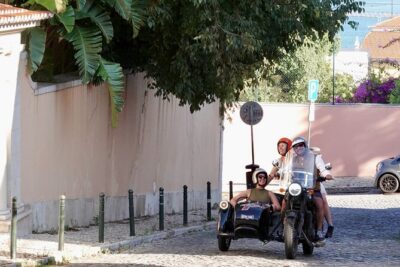
Lisbon Half-Day Handpicked – Private Vintage Sidecar Experience
Read our review →
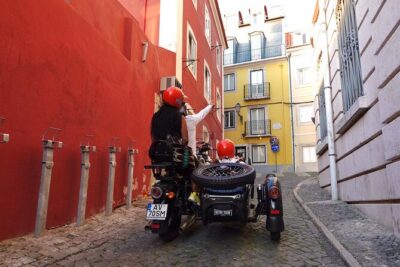
Lisbon El Cristo-Rei – Private Vintage Sidecar Tour
Read our review →
Browse the lists this tour appears in