
Reviewed · AUDIO TOURS
Electric Car with GPS Audio Guide Full Day Tour in Lisbon
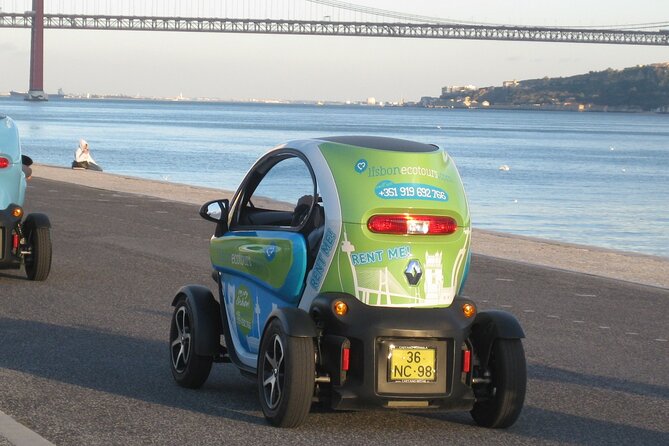
Zip around Lisbon with a GPS-guided Twizy.
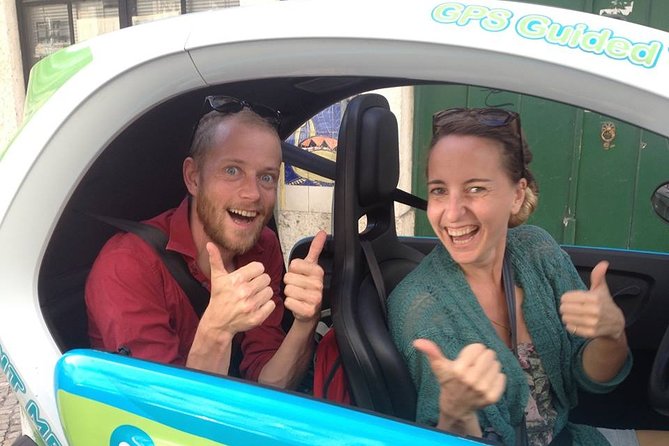
I like how the GPS audio guide keeps you moving from landmark to landmark without feeling rushed, and I like the freedom to steer your own stops once you arrive. One catch: you are driving a two-seater Twizy, so you need a valid driving license and you’ll deal with a 150€ cash security deposit.
This is a smart way to get your bearings fast, especially if you want to see the classic postcard sights and then wander a bit on your own. Just note the big monuments along the route are not automatically included, so you should budget for on-site tickets where applicable.
In This Review
- Key points worth your attention
- Why a Twizy GPS Tour Works So Well in Lisbon
- Price and what that 6 hours is really buying
- Getting started at R. da Madalena 67, and what to know before you drive
- Jerónimos Monastery: UNESCO scale and Manueline detail
- Belém Tower: defense turned lighthouse, still unmistakably Portuguese
- Rossio Square and Alfama: Lisbon’s daily life between monuments
- São Jorge Castle: the hilltop silhouette and the story layers
- Lisbon Cathedral, Santa Maria Maior: Romanesque strength through disaster
- Terreiro do Paço and Praça do Comércio: Lisbon’s riverfront “front door”
- São Vicente de Fora: patron-saint devotion and monastery origins
- The 25 de Abril Bridge: engineering, symbolism, and a San Francisco look
- Senhora do Monte viewpoint: one of Lisbon’s highest panoramas
- Bairro Alto: Chiado energy, São Roque Church, and quake reminders
- Included vs. not included: the real ticket math
- Who should book this Lisbon Eco Car tour, and who should skip it
- Should you book it?
- FAQ
- Is the GPS audio guide available in English?
- How long does the Lisbon electric car tour last?
- Do I need to drive the Twizy, and do I need a license?
- Where do I meet, and where does the tour end?
- Is monument admission included for the main stops?
- What is included in the tour price?
- What is not included?
- Is there a cancellation option?
Key points worth your attention
- A true GPS-led day, not a live narration bus. The route and timing are handled for you, in English.
- Twizy driving experience in a compact two-seater, with car insurance included and free parking.
- Big Lisbon hits in one loop, including Jerónimos, Belém Tower, São Jorge Castle, and the Cathedral.
- Audio stops with breathing room, because you get set time for closer looks at churches, viewpoints, and squares.
- Manueline architecture and UNESCO World Heritage show up repeatedly, so the style makes sense as you go.
- Photo-and-walk viewpoints are built in, including Senhora do Monte for wide panoramas.
Some other seven-hills days worth pricing up
- Lisbon: São Jorge Castle E-Ticket and Audio Guide★ 4.3 · 2,182 reviews
- Lisbon: Tram 28 Entry Ticket & Audio Guide with 24-Hour Pass★ 4.0 · 930 reviews
- Lisbon: Jerónimos Monastery E-Ticket and Audio Guide★ 3.7 · 660 reviews
- From/To Lisbon: Sintra Hop-on Hop-off Tickets + Audio Guide★ 3.7 · 119 reviews
Why a Twizy GPS Tour Works So Well in Lisbon
Lisbon is built on hills and tight neighborhood streets, which means a bus can feel like a long holding pattern. This tour uses a compact electric car, so you can move with less friction and spend your energy on the stops that matter.
The GPS audio guide is the real engine here. Instead of constantly checking your phone, you follow a guided route with audio instructions and time built in for you to look up, step inside if you want, and then get back on track. That structure is great when it’s your first time in Lisbon, or when you just want a day that feels organized without feeling like a schedule drill.
I also like the balance of famous sights and practical “orientation” moments. You don’t just see monuments, you also hit Lisbon’s public squares and viewpoints that explain how the city connects.
Price and what that 6 hours is really buying
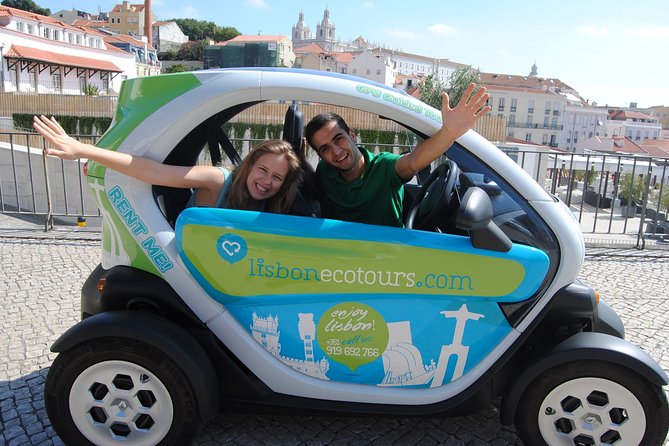
At $79.01 per person for about 6 hours, you’re paying for three things: the Twizy rental, the GPS audio guide, and the time at stops. Car insurance is included, and you get free parking, which quietly adds value because parking and getting close can be a headache in older city centers.
What you are not paying for: most monument admission tickets. Some stops explicitly list tickets as not included, including Jerónimos Monastery, Belém Tower, São Jorge Castle, Lisbon Cathedral (Santa Maria Maior), and several others. So if you plan to enter buildings, set aside extra money. If you’re happy with outside views and short walks, the tour stays excellent value.
Another factor is the “private tour” setup. That matters because you are not sharing your driving time with strangers, and you control the pace of how long you linger at each spot. You still follow the GPS route, but the day feels more like your own.
Getting started at R. da Madalena 67, and what to know before you drive
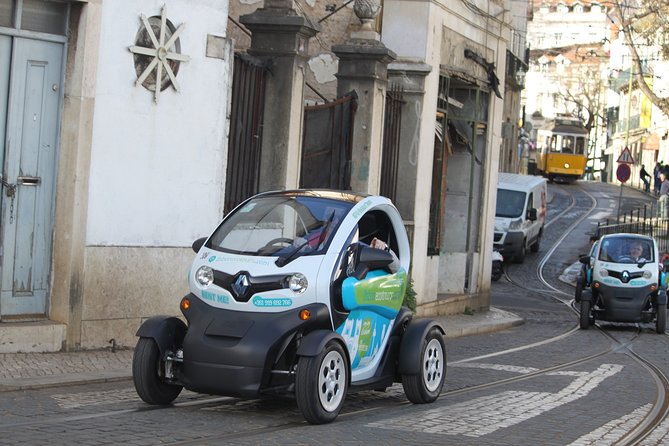
The meeting point is R. da Madalena 67, 1100-318 Lisboa, Portugal, and the tour ends back at the same place. You’ll start with a short intro at Lisbon Eco Tours, then roll into the main sightseeing loop.
A few practical points matter before you go:
- The Twizy is a two-seater car, so think through who is driving ahead of time.
- You need a driving license.
- There’s a 150€ cash security deposit held until the Twizy is returned.
- Children under 18 must be accompanied by an adult.
- This is in English, and you’ll have a mobile ticket.
If you are comfortable driving your own vehicle but you want a guide for directions, this is a great match. If you hate the idea of driving at all, this one can feel like you are doing more work than you expected.
Jerónimos Monastery: UNESCO scale and Manueline detail
Your day kicks off with the Jerónimos Monastery, Mosteiro dos Jeronimos. This is one of Lisbon’s most visited sites, and UNESCO named it a World Heritage Site in 1983. You’re also looking at Manueline style architecture, which is Portuguese late Gothic with lots of nautical and ornamental flourishes.
This monastery was designed by Diogo de Boitaca, meant to commemorate the return of Vasco da Gama from India. Construction began on 6 January 1501 and stretched until the 17th century, which explains why you see it as both ambitious and incomplete in spirit, even though it’s fully iconic now.
One more story layer that makes the visit stick: it was built on the site of the former Ermida do Restelo, the chapel where Vasco da Gama and his sailors prayed before setting out down the African coast to India. That’s the kind of detail you don’t always catch on a quick photo stop.
You get about 1 hour here, and since admission tickets are not included, decide in advance if you’re entering. If your time is tight, focus on exterior angles and key façades first, then use the extra minutes for deeper looks if the lines and ticketing feel manageable.
Other trips that start in Lisbon and end well:




Belém Tower: defense turned lighthouse, still unmistakably Portuguese
Next up is Torre de Belem, the Belém Tower, built between 1514 and 1520 by Francisco de Arruda in Manueline style. UNESCO also recognized it as a World Heritage Site in 1983.
This tower sits on the northern bank of the Tagus River and was originally used to defend the city. Later, it shifted roles, becoming a lighthouse and a customs house. That evolution helps you read the tower as both practical infrastructure and ceremonial architecture.
You get around 45 minutes at this stop, and admission tickets are not included. If you want to go inside, plan for that as part of your 45 minutes. If you don’t enter, you can still do well with waterfront walks, skyline photos, and a quick scan of the tower’s details from different angles.
The route timing is smart here. Belém is one of those zones where you can easily spend half a day. This portion keeps it tight, so you still have energy for the hills and neighborhoods later.
Rossio Square and Alfama: Lisbon’s daily life between monuments
From Jerónimos and Belém, the day pivots toward Lisbon’s living street level with Rossio Square, officially Praça de D. Pedro IV. It’s in Baixa, near Rua Augusta, close to Restauradores Square. Rossio is described as Lisbon’s nerve centre, and you can feel that right away: it’s one of the places where locals and visitors meet up, and the surrounding streets are packed with well-known restaurants, bars, and shops.
This is not a museum stop. It’s a reset. Use it to orient yourself. Check street names, take a slow look down the avenues, and get a feel for where you want to wander later.
After that, you move into Alfama, one of Lisbon’s most genuine neighborhoods with old, colorful buildings that give it a joyful character. Alfama is also linked to two of the city’s neighborhoods on the castle hill area, including itself and Castelo, which sets you up for the next big viewpoint and fortification stop.
If you like neighborhood texture as much as monuments, this part is a good use of time. If you want only the biggest interiors, you may find Alfama and Rossio more about walking and watching people than checking doors.
São Jorge Castle: the hilltop silhouette and the story layers
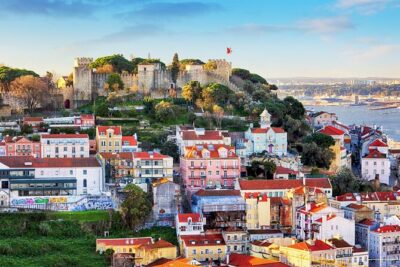
São Jorge Castle, Castelo de São Jorge, is one of Lisbon’s most emblematic landmarks. Even from afar, the silhouette grabs your attention. The castle sits on São Jorge hill, the highest in Lisbon, and it towers over the surrounding neighborhoods, including Alfama and Castelo.
Here’s what makes this stop more than a viewpoint. The site includes layers of occupation and rebuilding: a small fortress built by the Visigoths in the 5th century, enlarged by the Moors in the mid-11th century, modified under Afonso I of Portugal, and later transformed into a royal palace. The castle was fully restored in 1938.
You get about 1 hour here, and admission tickets are not included. That hour is enough to take in views, walk key sections, and still avoid turning it into a marathon. If you’re the kind of person who loves reading stones and walls, this place rewards you more than you’d expect for a simple hilltop stop.
Lisbon Cathedral, Santa Maria Maior: Romanesque strength through disaster

Your next major landmark is Lisbon Cathedral, known officially as Santa Maria Maior. Its construction dates from the 12th century and it’s predominantly Romanesque in style.
The reason this stop matters: it survived major upheavals, including the earthquake of 1755, which left part of the building in ruins. Over the centuries, renovations and rebuilds reshaped it again and again.
You get about 45 minutes, with admission tickets not included. If you want to step inside, plan to use some of that time for security checks and settling into the space. If you don’t go in, the outside still gives you that grounded sense of medieval Lisbon that you won’t get from viewpoints alone.
This is also a helpful pause after São Jorge. You move from sweeping horizons back into stone-level detail.
Terreiro do Paço and Praça do Comércio: Lisbon’s riverfront “front door”
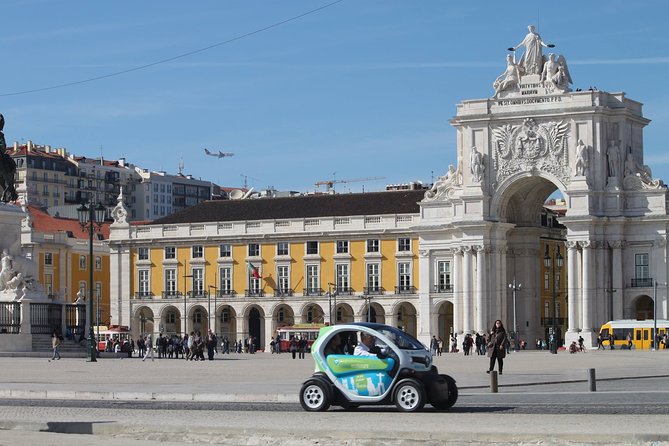
Praça do Comércio, also called Terreiro do Paco, is Lisbon’s main square. It was built on the site of the old Royal Palace, destroyed in the 1755 earthquake, so the place carries a rebuilding story in its layout.
The square’s southern end opens toward the Tagus River. The other three sides have yellow-colored buildings with arcades running along the façades. In the early days, commercial ships unloaded goods directly onto this square, which is why it was treated as Lisbon’s “door.”
You also have a practical bonus here: near the river bank is the Cais de Sodré ferry terminal, where ferries depart down the Tagus River. The tour doesn’t promise a ferry ride, but it does set you up to consider it if you want to extend the day later.
You get about 45 minutes here, and tickets are not included. This stop is great for a breath, a photo, and a quick plan for your next hill and neighborhood push.
São Vicente de Fora: patron-saint devotion and monastery origins
I like this stop because it feels less like a “check the box” landmark and more like a real living religious complex. Igreja de São Vicente de Fora, the Church and Monastery of São Vicente de Fora, honors Lisbon’s patron saint since 1173, São Vicente.
The origins go way back, including a connection to troops camping when Lisbon was taken from the Moors in 1147. The building you see now was built between 1582 and 1629, which helps explain why it feels solid and mature rather than like a quick chapel.
You get about 30 minutes, with admission tickets not included. That’s enough for a focused visit. If you enter, keep your expectations aligned with time. In this kind of setting, the best strategy is to pick a couple of highlights rather than trying to see everything.
The 25 de Abril Bridge: engineering, symbolism, and a San Francisco look
The 25th April Bridge, Ponte 25 de Abril, is the longest suspension bridge in Europe, and it has two levels. Cars use the top level, and the lower level, added in 1999, is for trains.
There’s also a political and historical story in the name. Originally named Salazar Bridge after António de Oliveira Salazar, it was renamed 25 de Abril after the Carnation Revolution, which took place on 25 April 1974 and ended Salazar’s regime.
Now for the fun, useful detail: the bridge was designed by the American Bridge Company, also responsible for the San Francisco Bridge. That’s why people often compare the look. Even if you don’t know the exact angles, you’ll likely notice the similarity once you see it from the right perspective.
Your GPS route includes this bridge as part of the day flow, and this tends to work well for photos and a quick pause rather than a long stop. If you want dramatic bridge shots, arrive prepared to step out and position yourself quickly once you park.
Senhora do Monte viewpoint: one of Lisbon’s highest panoramas
Miradouro da Senhora do Monte is in the Graça neighborhood and is listed as one of Lisbon’s most beautiful viewpoints, especially because it’s among the highest points in the city.
I love viewpoints that explain the city’s layout. Lisbon has many lookouts, but this one is valuable because you get a wide panoramic sense of how neighborhoods stack and how the river and urban fabric relate.
You get about 25 minutes, and tickets are not mentioned. That short time is ideal. Viewpoints can turn into long stops if you’re not careful, and 25 minutes gives you a chance to take photos, watch the light, then move on before your day drifts into tiredness.
Bairro Alto: Chiado energy, São Roque Church, and quake reminders
Your final neighborhood stop is Bairro Alto, framed alongside Chiado. The tour describes this as one of the best ways to explore two bohemian neighborhoods, filled with restaurants, bars, shops, and theaters, with an interesting past and plenty of character.
You also get a specific landmark mention: São Roque Church, plus a viewpoint and the remains of what’s described as the greatest earthquake in modern Europe. That means this isn’t just nightlife streets. It’s a layered area where you can bounce between architecture, views, and Lisbon’s long memory.
You get about 45 minutes at this stage, and tickets are not included. If you’re hungry later, this is also a practical end point, because there are plenty of places to grab a late bite in the surrounding streets.
Then you head back to the meeting point, and you’re done. No complicated transfers. No “we’ll see you later at another address.”
Included vs. not included: the real ticket math
Here’s the simplest way to think about costs. Included are the GPS audio guide, time for stops to get closer looks, free parking, and car insurance. Not included are food and drinks, and there’s no hotel pickup or drop-off.
Most importantly, several key monuments list admission tickets as not included. Based on what’s specified for the main stops, you should plan that at least some of these will cost extra if you choose to enter:
- Jerónimos Monastery
- Belém Tower
- São Jorge Castle
- Lisbon Cathedral (Santa Maria Maior)
- São Vicente de Fora
- São Roque Church (mentioned during the Bairro Alto, Chiado portion)
If you treat the interiors as optional and keep your pace brisk, this tour stays a smart buy. If you want to enter every major site and go slow, the day’s total spending will rise fast. Either way, the tour still pays off because the GPS handles route flow and the stop times prevent you from wasting the day getting lost.
Who should book this Lisbon Eco Car tour, and who should skip it
This is a great fit if you want:
- A GPS-led route in English that keeps you organized
- To combine landmark time with neighborhood walking, without a full-day classroom vibe
- To drive a compact electric Twizy and make the city feel more manageable
- Free parking plus car insurance, so your day doesn’t hinge on small logistics
It may not be the best fit if you:
- Don’t want to drive, even for a short city day
- Are sensitive to the idea of a 150€ cash deposit
- Prefer tours where every major admission is included in one price
Because the meeting point is fixed and the car is required, this works best for independent couples and small groups who are comfortable with self-directed navigation supported by audio.
Should you book it?
Yes, if your top priority is an efficient, well-paced Lisbon orientation with classic sights and viewpoints, and you like the idea of controlling your own time once you arrive. The $79.01 price feels reasonable because you get the car experience, the GPS audio guide, and the structured stop time, with parking and insurance handled.
Skip it if you want an all-in one ticket day, or if driving a Twizy sounds like a stress factor rather than a fun challenge. For the right person, this is a clean way to see Lisbon without turning your day into a checklist or a constant map hunt.
FAQ
Is the GPS audio guide available in English?
Yes. The tour offers the GPS audio guide in English.
How long does the Lisbon electric car tour last?
It lasts approximately 6 hours.
Do I need to drive the Twizy, and do I need a license?
Yes, driving is part of the experience. A driving license is required.
Where do I meet, and where does the tour end?
You meet at R. da Madalena 67, 1100-318 Lisboa, Portugal, and the activity ends back at the same meeting point.
Is monument admission included for the main stops?
Some admissions are included and others are not. For example, the Jerónimos Monastery, Belém Tower, São Jorge Castle, Lisbon Cathedral, and other listed monuments show admission tickets as not included.
What is included in the tour price?
Included items are the GPS audio guide, time to stop and look at points of interest, free parking, and car insurance.
What is not included?
Food and drinks are not included, and there is no hotel pickup or drop-off.
Is there a cancellation option?
Yes. There is free cancellation, and you can cancel up to 24 hours in advance for a full refund.
Fresh across the seven hills
- Full-day Private Tour: Fátima Sanctuary, Batalha, Nazaré, Óbidos
★ 5.0 · 6 reviews - Porto Private Tour from Lisbon
★ 4.5 · 6 reviews - VIP transfer from the airport to Lisbon hotels
★ 5.0 · 6 reviews - Lisbon Photoshoot: Capture Your Adventure
★ 5.0 · 6 reviews - Lisbon: Romantic Sunset Cruise With Wine & Portuguese Tapas
★ 5.0 · 6 reviews - Arrábida Wine Tour – 3 Wineries, Traditions & Views from Lisbon
★ 4.5 · 6 reviews - Lisbon: Sintra, Pena Palace, Belém Tour + sunset Boat Cruise
★ 5.0 · 6 reviews
Audio Tours, compared.
Tram 28 Entry Ticket & Audio Guide with 24-Hour Pass
Read our review →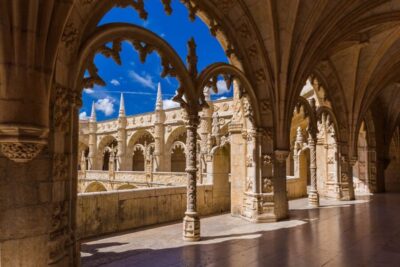

From/To Lisbon: Sintra Hop-on Hop-off Tickets + Audio Guide
Read our review →
National Palace of Ajuda E-Ticket & City Audio Guide
Read our review →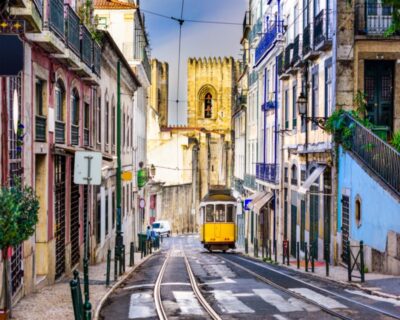
National Coach Museum Entry Ticket and Audio Guide
Read our review →
E-ticket to St. George with Audio Tour and Lisbon City Audio Tour
Read our review →Browse the lists this tour appears in