
Reviewed · WALKING TOURS
Walk Lisbon Like a Local: Bairro Alto & Downtown Experience
Lisbon’s best clues hide in plain streets. This 2.5-hour walk takes you from Praça Dom Pedro IV into Bairro Alto, with stories that connect stations, squares, churches, and the city’s big turning points. The route finishes at Miradouro de Santa Catarina, so you get your payoff view at the end, not five hours into your day.
I particularly like how the tour helps you get your bearings fast. You start in the downtown hub around Rossio, then move uphill and outward with a local guide keeping it practical. I also love the stop at Rossio Train Station, because you get a clear explanation of its Neo-Manueline look and the special intertwined horseshoe portals at the entrance.
One consideration: Bairro Alto is on a hill, so you’ll want decent walking comfort and moderate physical fitness. If stairs and slopes tire you quickly, plan for a slower pace and take it easy on the uphill sections.
In This Review
- Key highlights you’ll notice on this Lisbon walk
- Following the story from Praça Dom Pedro IV to Bairro Alto
- Rossio Station: a Neo-Manueline entrance that looks like a temple
- Camões Square: the poet who still lives in the street
- Bairro Alto: walls, a plague cemetery, and the Saint Roque relic
- Largo do Carmo: Nuno Álvares Pereira’s vow and a convent that mattered
- Ending at Miradouro de Santa Catarina, and why the timing is smart
- Value and logistics that keep this tour feeling low-stress
- Who this walk is best for (and who should think twice)
- Should you book this Bairro Alto and downtown Lisbon walk?
- FAQ
- Where does the tour start and end?
- How long is the walking tour?
- What is the price per person?
- Is the tour offered in English?
- Do I need to print a ticket?
- How big is the group?
- Is the tour physically demanding?
- Is there a refund if I cancel?
Key highlights you’ll notice on this Lisbon walk
- Rossio Station’s Neo-Manueline façade and the temple-like entrance details
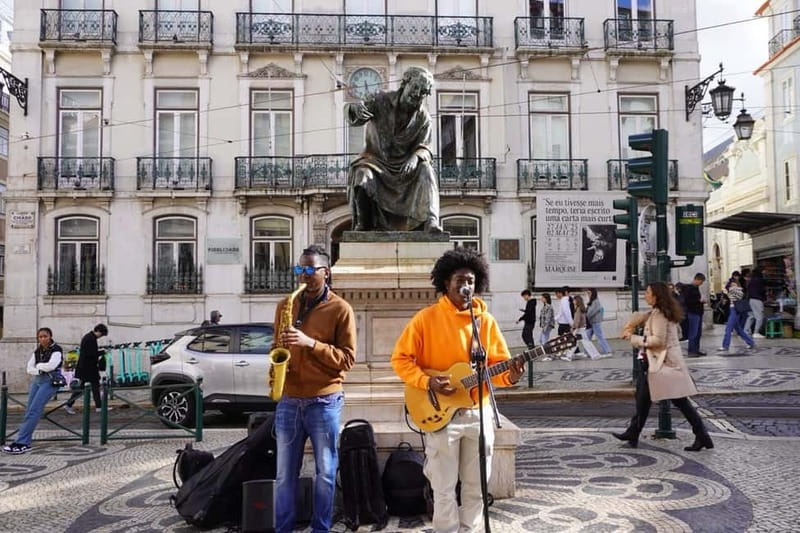
- Camões Square and why Luís de Camões still shapes Portuguese identity
- Bairro Alto’s city walls, plague cemetery, and Saint Roque relic story
- Largo do Carmo and Nuno Álvares Pereira’s vow turned into a convent
- A finish at Miradouro de Santa Catarina that feels like a reward
More Lisbon miradouros linked on foot:
- Lisbon: History, Stories and Lifestyle Walking Tour★ 4.8 · 10,902 reviews
- Best of Lisbon Small-Group Guided Walking Tour★ 5.0 · 4,869 reviews
- Lisbon: Food and Wine Small Group Walking Tour★ 4.9 · 4,082 reviews
- Best of Lisbon Walking Tour: Rossio, Chiado & Alfama★ 4.9 · 2,700 reviews
Following the story from Praça Dom Pedro IV to Bairro Alto
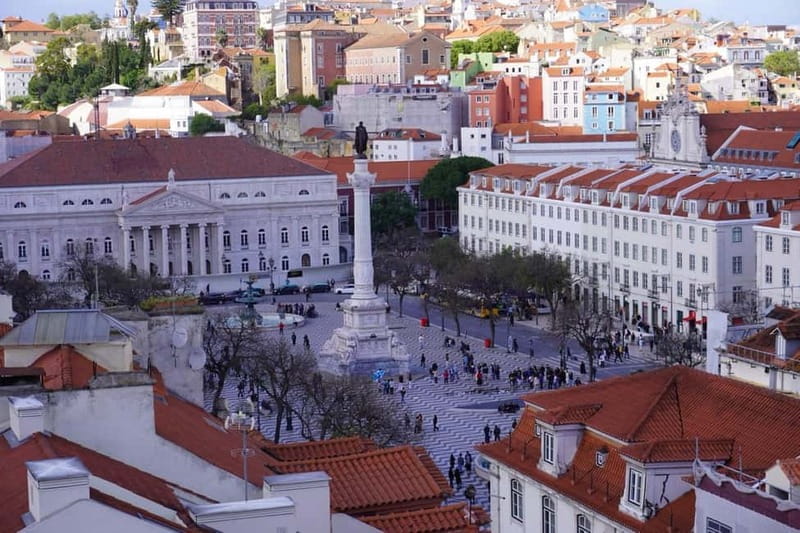
This tour is built for people who want more than a highlight stroll. You begin at Praça Dom Pedro IV, a central public square that works like a natural “pause and orient” point. From here, you move through Lisbon’s downtown layers, then toward the Bairro Alto area where streets climb and the atmosphere shifts. That shift matters. It’s one thing to read about Lisbon’s past, and another to feel how the geography shaped the city.
What I like is the pacing. You get a sequence of stops that each teaches one theme: transport and design at Rossio Station, literature and language at Camões Square, and then real neighborhood evolution in Bairro Alto. The timing is tight but not rushed, with plenty of time at each major moment. You’ll be moving for about 2 hours and 30 minutes total, so it’s long enough to matter, short enough to still keep your day flexible.
Also, the tour stays on foot the whole way with no private transportation. That’s a good thing for value and for context. When you walk, you notice small changes in elevation, street width, and the way churches and squares pull people in different directions. If you want the city to feel like a living place, not a museum route, this format helps.
Rossio Station: a Neo-Manueline entrance that looks like a temple
Rossio Train Station is one of those places you might speed past if you only have eyes for bigger attractions. Here, you get time to appreciate what makes the building unusual. The station was commissioned by the Portuguese Royal Railway Company and designed between 1886 and 1887 by Portuguese architect José Luís Monteiro. It was completed in 1890, which helps you place it in the broader story of Lisbon modernizing its connections.
The façade style is the real hook. It’s described as Neo-Manueline, a Romantic recreation of the exuberant Manueline look common in early 16th-century Portugal. Translation into practical terms: the station doesn’t just say train station. It reads like a grand public monument. When you look at the entrance, pay attention to the two intertwined horseshoe portals. They even include wording that calls it Central Station. Those details are the kind of design choice that turns a transit stop into an architectural clue.
You also learn the station’s functional role. It connected Lisbon to the region of Sintra, so it wasn’t only about downtown mobility. That matters because Bairro Alto and downtown Lisbon are still shaped by movement patterns, where people came from and where they ended up. Standing there for a while helps you understand why Rossio is such a strong anchor point for tours like this.
Tip for your walk: when you’re done looking at the entrance, take one extra minute to scan the overall façade as one piece. The temple-like feel comes from the whole front, not just one portal.
Camões Square: the poet who still lives in the street
Next you reach Praca Luis de Camoes, named for Luís de Camões, Portugal’s national poet. This stop is short, but it’s effective because it connects one person to how Portugal thinks and talks. You’ll hear that he’s credited as the author of the epic poem Os Lusíadas, which describes Vasco da Gama’s sea route to India.
You also get the human detail that makes Camões feel real: he’s said to have lost one eye in a battle in Ceuta. That story sticks because it adds weight to the myth. And then there’s the language angle. Portuguese language is sometimes called the language of Camões, which explains why this isn’t a name on a sign. It’s a cultural reference point.
For me, this is the kind of stop that makes the rest of the walk click. Bairro Alto isn’t only about buildings. It’s about why people chose certain areas, what they valued, and how the city kept reworking itself. Camões Square gives you a lens for thinking about Lisbon as a place where ideas travel as far as people do.
If you’re the type who likes to remember one fact per stop, aim to keep these two: Os Lusíadas and the idea that Portuguese is sometimes linked to Camões. Those are easy anchors when you’re later trying to connect everything you saw.
Bairro Alto: walls, a plague cemetery, and the Saint Roque relic
Bairro Alto is the emotional center of this experience. You spend real time here, because this neighborhood is a layered story, and the walk gives you a chance to absorb it slowly. The big idea is how the city’s growth forced changes in space, gates, and social geography.
You’ll hear that in the late 15th century Lisbon was packed with people from all over the world due to the discovery era. The center needed expansion, and the area around what is now Camões Square used to be an entrance to the city. Earlier layers of defense and passage matter too. The discussion includes the fernandine wall and the door of Santa Catarina at the location where, after the earthquake, you have two churches: Encarnação and Loreto.
Then the story turns darker, but in a way that makes sense geographically. On the other side of the wall were areas connected to rich noble families. Up on the hill was a cemetery for victims of the black plague. This is where you start to feel how the city organized itself around inequality and fear, and how proximity to spiritual sites could become a survival strategy.
The follow-up detail ties religion to urban planning. In 1506, King Manuel I requested a relic of Saint Roque from Venice and placed it in a hermitage near the cemetery. As the arrival of black plague and demographic increase continued, the less fortunate and the sick ended up moving closer to the church. In response, an urban plan developed to receive these people.
That sequence is powerful because it explains Bairro Alto as a response to pressure, not just an artsy hill. It’s not saying one thing about the present and leaving the past behind. It shows how Lisbon’s streets were shaped by crisis, hope, and policy decisions.
How to enjoy this part of the walk: look for the relationship between elevation and sightlines. In Bairro Alto, you’re always aware of the hill. Use that. It helps you imagine where people moved, where they could see approaching crowds, and where the neighborhood likely felt safer or more exposed.
Other trips that start in Lisbon and end well:


Largo do Carmo: Nuno Álvares Pereira’s vow and a convent that mattered
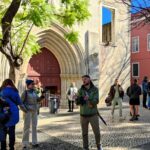
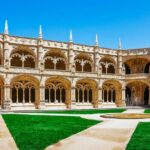
Largo do Carmo is a smaller stop on paper, but it delivers a focused story. Here you’re at the church and convent built in 1389, linked to Nuno Álvares Pereira. The tour connects him to the conflict with Castilian troops. He vowed to build the world’s most beautiful church if he defeated the Castilians in 1385 at the battle of Aljubarrota.
When the Portuguese came out victorious, he kept his word. He funded the construction of the Carmelite church and convent. The detail that helps the story land is what happened after construction. After it was completed in 1423, Nuno Álvares Pereira joined the Carmelite order and spent the rest of his life in the convent.
Even if you’re not a history fanatic, this is an easy narrative to remember because it has cause and effect built in. Vow, battle, construction, and then lifelong devotion. That’s the kind of storyline that turns a public space into something you can picture.
Practical note: since this is a walking tour, the short stop here gives you a break before the final stretch. If you want a moment to reset, this is a good place to do it.
Ending at Miradouro de Santa Catarina, and why the timing is smart
The tour finishes at Miradouro de Santa Catarina, which is exactly what you want for a walking experience. After 2.5 hours of streets and stories, the viewpoint gives your brain a place to rest. It also lets you connect the route you just walked to the city’s layout in a way photos don’t always do.
This matters more than it sounds. When you walk through Rossio and then up toward Bairro Alto, Lisbon’s hill geography becomes part of the experience. By the time you reach the miradouro, you can look out and see the consequences of that geography: where neighborhoods feel stacked, where viewpoints sit like punctuation marks, and why certain areas became gathering points.
If you like to take photos, you’ll probably get your best angles at the end. But don’t treat the miradouro as just a photo station. Try to use it as a map check. Look back toward the direction you came from. The stories you heard start to feel more grounded, because you can connect them to actual lines of sight and real terrain.
Value and logistics that keep this tour feeling low-stress
Let’s talk about value first. The price is $3.60 per person, which is remarkably low for a 2.5-hour walk with an expert local guide. You’re also getting a mobile ticket, and the tour includes intriguing stories and legends built into the pacing. For Lisbon, where many walking experiences cost significantly more, this one stands out on value alone.
Another advantage: the tour runs with a maximum of 30 travelers. That’s not huge, and it helps the guide manage the group without the experience turning into a moving lecture where you can’t hear anything. It also makes it easier to ask practical questions if something doesn’t click.
The route also includes stops with admission tickets marked as free. That means you’re not forced into paying for entry just to keep moving. One thing to know is that entry to the Santa Justa elevator is not included, so don’t build your day plans around this tour including that attraction.
Logistics are simple. You start at Praça Dom Pedro IV, 1100-200 Lisboa, Portugal. You end at Miradouro de Santa Catarina, 1200-262 Lisboa, Portugal. It’s near public transportation, which helps if you want to return to the rest of your itinerary with less backtracking.
For comfort, plan for moderate fitness. Lisbon’s sidewalks are not always flat. Bairro Alto has slopes. Even when the walking doesn’t feel extreme, it can add up after two hours. Wear shoes you trust on uneven pavement, and keep a water bottle handy if it’s a warm day.
Who this walk is best for (and who should think twice)
This tour fits best if you want a short, story-driven introduction to downtown Lisbon plus Bairro Alto. If your time is limited and you want to reach areas you might otherwise skip, this format is a smart use of time. The stop mix also helps if you like variety: architecture at Rossio Station, poetry at Camões Square, and neighborhood evolution around Bairro Alto.
It’s also a good choice if you like a guide who connects facts into a storyline. The details here are not random. They build a chain: transportation and design, cultural identity, then the neighborhood’s social history, then a church story tied to a real vow and a real battle.
If you strongly prefer only one type of experience, say purely scenic viewpoints or purely museum interiors, this might feel more “walking and learning” than “sightseeing and chilling.” Also, if you struggle with hills and uneven streets, you’ll want to be realistic about the Bairro Alto portion. Moderate fitness is your cue.
Should you book this Bairro Alto and downtown Lisbon walk?
I think you should book it if you want an efficient, friendly introduction to Lisbon’s layers in under half a day. The guide format, the free admission stops, the small-ish group size, and the very low price make it a practical choice. Most importantly, the experience connects Rossio, Camões Square, and Bairro Alto into a single understandable story, and the end viewpoint makes it feel like a complete loop.
I’d skip it or choose a different option if your priority is major attraction entry tickets or if the hill walking in Bairro Alto would be a real problem. But for most people, this is an easy yes, especially if you like learning on foot and you want Lisbon to feel personal, not just photographed.
FAQ
Where does the tour start and end?
The tour starts at Praça Dom Pedro IV (1100-200 Lisboa, Portugal) and ends at Miradouro de Santa Catarina (1200-262 Lisboa, Portugal).
How long is the walking tour?
It lasts about 2 hours 30 minutes.
What is the price per person?
The listed price is $3.60 per person.
Is the tour offered in English?
Yes, the tour is offered in English.
Do I need to print a ticket?
No. You get a mobile ticket.
How big is the group?
The tour has a maximum of 30 travelers.
Is the tour physically demanding?
It’s described as requiring moderate physical fitness level.
Is there a refund if I cancel?
Yes, you can cancel for a full refund if you cancel up to 24 hours in advance of the experience’s start time.
Fresh across the seven hills
- Private Tour from Porto to Lisbon with Stops
★ 5.0 · 6 reviews - Lisbon: Private Highlights Tuk-Tuk Tour with Tapas and Wine
★ 5.0 · 6 reviews - Lisbon: The Ultimate Food Tour with a Local
★ 3.7 · 6 reviews - Treasures of Lisboa : Alfama Food Tour with 18 Tastings
★ 5.0 · 6 reviews - Lisbon: Portuguese Petiscos Cooking Class
★ 4.7 · 6 reviews - Seixal Sailing Cruise – Lunch in a typical restaurant
★ 5.0 · 6 reviews - Nature, Wines and Ceramic Tiles: Private Tour
★ 4.0 · 6 reviews
Walking Tours, compared.
Best of Lisbon Small-Group Guided Walking Tour
Read our review →
Best of Lisbon Walking Tour: Rossio, Chiado & Alfama
Read our review →

Sintra & Cascais Day Tour with Pena Palace Entry and Gardens Walk
Read our review →
Lisbon Roots – Small group Food & Culture Walking Tour w/tastings
Read our review →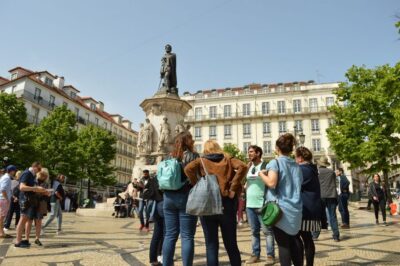
Starter Walking Tour to the highlights in German
Read our review →Browse the lists this tour appears in